How do you help a child when a pet dies?
How to explain a pet’s death clearly, make room for a child’s grief, answer hard questions, and know when your family may need more support.
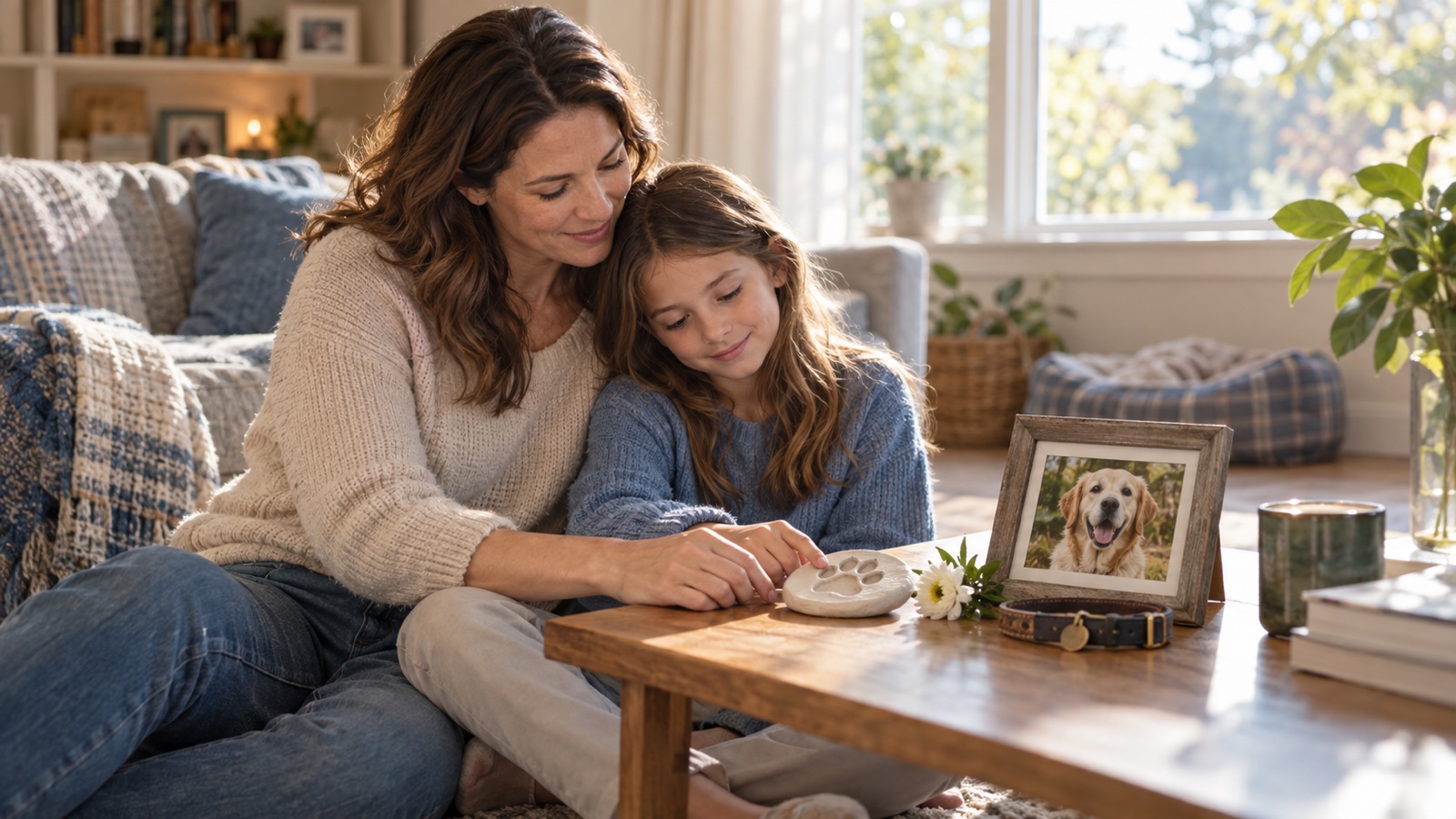
- Use clear words such as “died” rather than saying the pet went to sleep or went away.
- A child’s grief may appear as sadness, anger, play, repeated questions, physical complaints, or brief returns to ordinary life.
- Let your child choose a simple way to remember the pet without making one ritual mandatory.
- Persistent impairment, traumatic symptoms, self-blame, or safety concerns deserve professional support.
The food bowl is still beside the cabinet. Your child notices it before you do, stops in the hallway, and asks when the dog is coming home. You’re grieving too, and now you’re expected to explain death while yesterday’s tennis ball is sitting under the chair like nobody consulted it.
For many children, a pet’s death is their first close loss. The relationship may have held routine, comfort, play, and a steady witness to childhood. Helping doesn’t mean finding a sentence that removes the pain. It means giving the loss clear words, safe company, and enough room to change shape.
Say what happened without making sleep sound dangerous
Use direct, age-appropriate language: “Milo died. His body stopped working, and he can’t come back.” Younger children may not understand permanence yet, so they may ask the same question again tomorrow. Repetition isn’t defiance. They’re building the idea one piece at a time.
Avoid saying the pet “went to sleep,” “was lost,” or “went away.” A literal child may become afraid of bedtime, worry that lost things die, or wait for the pet to return. Clear language can feel harsher to an adult, but confusion isn’t gentler.
Answer the question that was asked, then pause. You don’t need to deliver the entire biology of death before breakfast. “Will she be cold?” may need a short factual answer and reassurance that she isn’t feeling pain, not a lecture with slides.
Children don’t grieve in one visible lane
Your child may cry, get angry, become clingy, complain of a stomachache, reenact the story in play, or ask to watch a show five minutes later. That quick return to ordinary life doesn’t mean the pet didn’t matter. Children often move in and out of grief because they can’t stay inside its full intensity all day.
Research on childhood pet loss suggests the experience can be associated with later emotional distress, while the response varies with attachment, age, circumstances, and other supports. Association isn’t destiny. It tells us not to dismiss the loss as “just a pet.”
I’ll often tell parents to watch behavior as well as words. A child who says “fine” may start sleeping in your room, refusing school, checking constantly on another pet, or exploding over small separations. The grief may be speaking without requesting the microphone.
Your sadness can be visible without becoming their job
It’s okay for your child to see you cry and hear, “I miss her too.” That shows sadness can be shared and survived. It’s less helpful if your child must stop grieving to monitor you, reassure you, or become the household’s smallest bereavement counselor.
If you’re overwhelmed, get adult support from someone else. You can say, “I’m very sad, and I’m taking care of myself. You don’t have to fix it.” That sentence lets your child see honest emotion with a railing around it.
Family members may grieve differently. One child wants every photograph out. Another doesn’t want to talk. Someone else asks about getting a new puppy before the collar is put away. Different timing isn’t a measure of who loved the pet most.
Guilt needs facts, not automatic reassurance
Children can assume their angry thought, forgotten water bowl, open gate, or wish for a different pet caused the death. Ask gently, “Do you think anything you did made this happen?” Then correct the specific belief. “You being mad at him didn’t make his heart stop” is more useful than “don’t be silly.”
If euthanasia was involved, explain it in words your child can understand: the pet was very sick or badly hurt, treatment couldn’t make the body well, and the veterinarian used medicine so the pet could die without more suffering. Don’t call it “putting to sleep.” Your child may ask whether you decided too soon. You can acknowledge how hard the decision was without handing them adult responsibility for it.
If the death was sudden, violent, or witnessed, the frightening images may compete with every good memory. Don’t press for details, but don’t pretend nothing scary happened. Nightmares, replaying the scene, intense avoidance, or persistent hypervigilance may call for trauma-informed professional support.
A small ritual gives love somewhere to go
Invite your child to choose, not perform, a way to remember. They might draw a picture, plant something, make a photo book, write a note, share a funny story, donate a toy, or keep the collar in a special place. Studies of continuing bonds suggest children often maintain connection through memories and symbolic acts, though the form changes with age.
Let the ritual fit your family’s culture and beliefs. You can say what you believe happens after death and distinguish belief from fact: “In our family, we believe...” It’s fine to admit what you don’t know. Certainty borrowed for the occasion tends to wobble later.
Keep ordinary routines where you can. Meals, school, bedtime, and the walk you no longer need to take can feel painfully altered, but predictability helps. You might keep the walk for a week and let your child decide whether it feels comforting or awful. Grief doesn’t award points for using every suggestion.
A new pet shouldn’t be assigned the old pet’s job
There’s no universal waiting period before another animal joins the family. Talk about readiness, practical care, and everyone’s wishes. A new pet can bring joy, but it won’t replace the relationship that ended, and it shouldn’t be introduced as medicine for sadness.
If a child refuses ever to love another animal, don’t debate them on the worst day. If they want a puppy immediately, don’t treat that as proof they’ve moved on. Both responses can be attempts to make an uncontrollable loss feel controllable.
Know when grief needs more company
There isn’t one correct timetable. Seek help when distress stays intense, worsens, or persistently disrupts sleep, school, eating, friendships, play, or basic care. Also pay attention to severe self-blame, repeated panic, traumatic reexperiencing, substance use, hopelessness, self-harm, or talk about wanting to die.
A pediatrician or child mental health professional can assess grief alongside depression, anxiety, trauma, and other stressors. If your child may act on suicidal thoughts or can’t stay safe, call or text 988 in the United States, call 911 for immediate danger, or go to an emergency department.
Today, ask one small question: “What do you miss most right now?” Write the answer beside a photograph or draw it together. You’re not forcing closure. You’re helping love become a memory the family can carry without pretending the empty bowl isn’t there.
The bottom line: A pet’s death can be a profound childhood loss. Use clear language, welcome different forms of grief, correct guilt with specific facts, offer a choice of rituals, and seek help when distress or traumatic symptoms keep a child from living their daily life.
Sources: American Academy of Pediatrics, HealthyChildren.org, When a Pet Dies and How Children Understand Death; Dunn and colleagues, childhood pet death and mental health, European Child & Adolescent Psychiatry (2022); Packman and colleagues, pet loss and continuing bonds in children and adolescents, Anthrozoos (2020); Kogan and colleagues, qualitative systematic review of pet-loss grief, Death Studies (2022); National Child Traumatic Stress Network, Childhood Traumatic Grief materials.

Why grief comes in waves
Why ordinary moments can bring loss back without erasing progress.
How do you help a child when a parent is seriously ill?
How honest language and predictable care can protect a child.

Why is my child suddenly afraid to sleep alone?
How to respond to nighttime fear without making it the new rule.
Has grief begun to crowd out your child’s daily life?
A free 15-minute intro call can help you decide whether psychiatric care fits the next step.